Kenmore Model 417 Washer Dryer Combo Repair Manual: Overview
This manual provides comprehensive repair information for the Kenmore Model 417 washer dryer combo. It covers various sub-models, common issues, and detailed disassembly instructions.
Access to wiring diagrams, parts lists, and troubleshooting guides are included. Resources like Repair Clinic and Appliantology.org are also referenced for further assistance.
Model Number Variations
Kenmore Model 417 encompasses a range of sub-models, each with slight variations. Identifying the precise model number is crucial for accurate parts ordering and repair procedures. Common variations include 417.94712400, 417.94702300, 417.94862302, and 417.98702891.
Further examples are 417.61712510, 417.99190100 (or 41799190100), and 417.99980130. These numbers often indicate minor differences in features or components. Referencing the appliance’s data plate, typically located inside the door or on the back panel, is essential.
Confirming the full model number on sites like Repair Clinic ensures compatibility when sourcing replacement parts. Variations also exist within the Source 417 dryer models, such as 417.84052500 and 417.84092500.
Identifying Specific Sub-Models
Precisely identifying your Kenmore 417 sub-model is vital for accessing the correct repair resources. The full model number, often a 10-12 digit code, differentiates specific configurations. Begin by locating the appliance’s data plate, usually inside the door or on the rear panel.
Cross-reference this number with online parts retailers like Repair Clinic to validate its accuracy. Variations like 417.99190100 require specific parts catalogs and repair manuals.
The Appliantology.org forums can assist in deciphering less common model numbers; Service manuals, such as Pub 26210305 for Source 417 dryers, cover a range of related sub-models, but confirmation is key for successful repairs.
Common Issues & Troubleshooting
Kenmore 417 combo units frequently exhibit issues with water drainage and heating element failure. Drain pump clogs, often from small objects, prevent complete water removal, leading to error codes. A malfunctioning water inlet valve can also cause filling problems.
Dryer-related concerns often involve a faulty thermal fuse or heating element. If the dryer doesn’t heat, check the thermal fuse first, as it’s a common point of failure.
Consult the repair manual for specific error code definitions and troubleshooting steps. Online forums like Appliantology.org offer user-shared solutions and diagnostic advice for common Kenmore 417 problems.

Disassembly & Access
This section details accessing internal components. It covers removing the control panel, and disassembling both the washer and dryer sections for repair purposes.
Accessing Internal Components
Before attempting any disassembly, ensure the appliance is completely disconnected from both power and water sources for safety. Begin by removing the exterior panels, typically secured with screws located around the perimeter and potentially underneath the unit.
Carefully note the location of each screw as you remove them, as they may vary in size. Once the panels are off, you’ll gain access to the internal framework. The control panel is usually held in place by retaining clips or screws, allowing for its removal and revealing the wiring harness.
Further access to the washer and dryer components requires navigating through this internal structure, often involving the removal of additional panels and brackets. Always consult detailed diagrams or repair manuals for specific screw locations and component arrangements.
Removing the Control Panel
Disconnecting power is paramount before proceeding with control panel removal. Typically, the Kenmore 417’s control panel is secured by screws located either directly on the panel’s face or hidden beneath a trim piece at the top. Gently pry off the trim piece if present to reveal these screws.
Once the screws are removed, carefully pull the control panel forward. Be mindful of the ribbon cables and wiring connectors attached to the back of the panel. These connectors should be gently disconnected by releasing any retaining clips or screws securing them.
Label each wire before disconnecting to aid reassembly. Documenting the process with photos is also highly recommended. With all connections detached, the control panel can be fully removed for inspection or replacement.
Washer Section Disassembly
Begin by disconnecting the water inlet and drain hoses from the washer section. Accessing internal components usually requires removing the top or front panel, depending on the specific sub-model. Once the outer panels are off, you’ll encounter the wash basket and associated components.
The wash basket is typically held in place by a center support shaft and a retaining nut. Removing this nut allows the basket to be lifted out. Pay attention to the location of the belt connecting the motor to the basket, as it will need to be detached.
Further disassembly may involve removing the pump and inlet valve, secured by screws or clips. Document each step for easier reassembly.

Washer Repair
This section details repairs for the washer portion of the Kenmore 417 combo. It covers water inlet valve, drain pump, and belt replacements with step-by-step guidance.
Water Inlet Valve Replacement
Replacing the water inlet valve on the Kenmore 417 combo requires careful disconnection of water lines and electrical connections. Begin by shutting off both hot and cold water supplies to the unit, and disconnecting the power.
Locate the valve, typically at the rear of the appliance, and detach the hoses. Disconnect the electrical connector, noting its orientation for reassembly. Remove any mounting screws securing the valve, and carefully extract the old valve.
Install the new valve, ensuring proper alignment and secure connections of hoses and the electrical connector. Double-check all connections before restoring water and power. A faulty inlet valve often prevents filling or causes overfilling, so testing is crucial after replacement.
Drain Pump Repair
Repairing the drain pump on the Kenmore 417 combo often involves checking for obstructions first. Disconnect power and access the pump, usually located at the base of the washer section. Inspect the pump’s inlet for lint, coins, or other debris that may be causing a blockage.
If the pump is obstructed, carefully remove the blockage. If the pump motor is faulty, replacement is typically necessary. Disconnect the electrical connector and hose clamps, then remove the old pump.
Install the new pump, ensuring secure hose connections and a proper electrical connection. Test the unit after repair to confirm proper draining. A failing drain pump results in water remaining in the washer drum.
Belt Replacement (Washer)
Replacing the washer belt on the Kenmore 417 requires accessing the motor and pulley system. Begin by disconnecting power and removing the cabinet panels to expose the washer’s internal components. Locate the motor and the drive pulley connected to the washer drum.
Release tension on the belt tensioner to remove the old belt. Note the belt’s routing before removal for correct reinstallation. Install the new belt, ensuring it’s properly seated on all pulleys.
Re-engage the tensioner and verify the belt’s alignment. A worn or broken belt prevents the washer drum from spinning during the wash cycle. Proper belt tension is crucial for optimal performance.
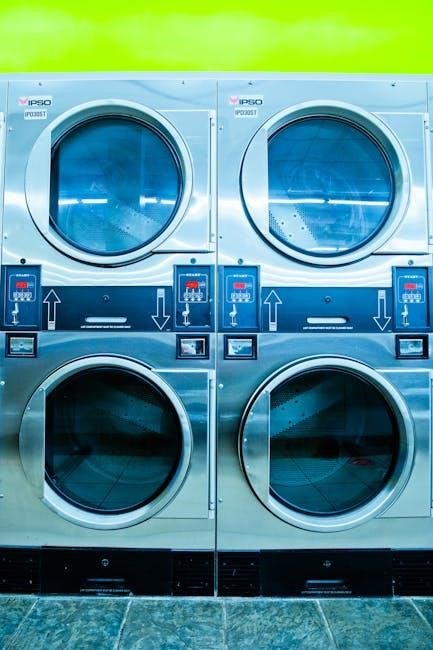
Dryer Repair
This section details dryer repairs, including heating element, thermal fuse, and drum roller replacements. Troubleshooting guides and component locations are provided for efficient service.
Heating Element Replacement
Replacing the heating element in your Kenmore 417 combo unit requires careful disconnection of power and access to the dryer section. Begin by disconnecting the appliance from both electrical and gas supplies (if applicable). Remove the rear access panel to locate the heating element housing.
Disconnect the wiring connectors attached to the heating element, noting their positions for reassembly. Carefully remove the old heating element, observing how it’s secured – often with screws or clips. Install the new heating element, ensuring it’s properly seated and secured. Reconnect the wiring connectors, verifying a secure connection.
Finally, reassemble the rear access panel and test the dryer function. Always prioritize safety and consult wiring diagrams if unsure about any connections.
Thermal Fuse Replacement
The thermal fuse is a crucial safety component within the Kenmore 417 dryer, preventing overheating. A blown fuse indicates a potential airflow restriction or other overheating cause that must be addressed. Begin by disconnecting power to the appliance. Access the thermal fuse, typically located near the heating element or blower housing, via the rear panel.
Disconnect the wires connected to the fuse, carefully noting their positions. Remove the old fuse and install the new one, ensuring it’s the correct amperage and type. Reconnect the wires securely.
Before restoring power, investigate and resolve the underlying cause of the blown fuse. Simply replacing it without addressing the root issue will likely result in another failure.
Drum Roller Replacement
Worn drum rollers cause excessive noise and vibration during the dryer cycle of the Kenmore 417; Begin by disconnecting power. Access the rollers by removing the front panel, often requiring removal of the top panel first. Carefully note the roller placement before removal, as they may vary in size or design.
Support the drum while removing the old rollers. They are typically held in place by a retaining clip or bracket. Install the new rollers, ensuring they are securely seated in their brackets.
Test the drum’s rotation to confirm smooth, quiet operation. Reassemble the dryer, ensuring all panels are properly secured before restoring power.
Control Board & Wiring
This section details control board diagnostics, wiring diagram locations, and replacement procedures for the Kenmore 417. Proper testing and careful wiring are crucial.
Control Board Diagnostics
Diagnosing the control board requires a systematic approach. Begin by visually inspecting the board for any burned components, swollen capacitors, or damaged traces. Utilize a multimeter to check for continuity and voltage at key test points, referencing the wiring diagram.
Error codes displayed on the unit can provide valuable clues. Consult the service manual for a comprehensive list of error codes and their corresponding meanings. A faulty control board may exhibit symptoms like unresponsive controls, erratic operation, or failure to start either the wash or dry cycle.
Carefully examine the board’s connectors and wiring harness for loose connections or corrosion. Before replacing the control board, verify that the issue isn’t related to other components, such as the user interface or sensors.
Wiring Diagram Locations
Locating the wiring diagram is crucial for successful repairs. Typically, a copy of the wiring diagram is affixed to the inside of the control panel, often behind the access panel or on the back of the control board itself.
The service manual, if available, will contain detailed wiring diagrams for all circuits. Online resources like Appliantology.org may also host wiring diagrams specific to the Kenmore Model 417. Searching for the specific sub-model number (e.g., 417;99190100) will yield more accurate results.
Always refer to the correct diagram for your specific model variation. Incorrect wiring can lead to further damage or safety hazards. Carefully trace the wires and components to ensure accurate identification;
Replacing the Control Board
Before replacing the control board, disconnect power and water to the unit. Carefully document the wiring connections to the existing board – photos are highly recommended! Remove the control panel as outlined in the disassembly section. Disconnect all wiring harnesses and ground wires from the old control board.
Install the new control board, ensuring all wiring is connected correctly. Double-check all connections against your documentation. Reassemble the control panel and restore power and water. Test all washer and dryer functions to verify proper operation.
If issues persist, re-examine wiring and consult the wiring diagram.
Parts & Resources
Finding replacement parts is crucial for repair. Utilize Repair Clinic and Appliantology.org forums for parts sourcing and expert advice on the Kenmore 417.
Finding Replacement Parts
Sourcing replacement parts for your Kenmore Model 417 washer dryer combo requires a strategic approach. Repair Clinic is a frequently cited resource, offering a vast inventory of appliance parts with same-day shipping and a generous 365-day return policy.
When searching, having the complete model number (e.g., 417.94712400, 417.61712510, 417.99190100) is essential for accurate part identification. Cross-referencing part numbers is also recommended to ensure compatibility.
Appliantology.org forums provide a community-driven platform where users share experiences and part sourcing tips. Experienced technicians often post links to reliable suppliers and offer guidance on identifying the correct components. Consider exploring these forums for valuable insights and potential cost savings.

Repair Clinic Resources
Repair Clinic stands out as a premier resource for Kenmore Model 417 washer dryer combo repair. They offer a comprehensive catalog of manuals, care guides, and literature specifically for this appliance, including parts catalogs and dedicated repair manuals.
Their website provides detailed diagrams and troubleshooting assistance, aiding in accurate diagnosis and repair. Beyond documentation, Repair Clinic boasts a substantial inventory of replacement parts, ensuring quick access to necessary components.
Fast shipping options and a 365-day return policy enhance the customer experience. Utilizing their model number search function guarantees compatibility, streamlining the parts selection process. Repair Clinic’s resources empower both DIY enthusiasts and professionals to effectively address appliance issues.
Appliantology.org Forums
Appliantology.org serves as a valuable community forum for Kenmore Model 417 washer dryer combo repair enthusiasts and professional technicians alike. This “Master Samurai Tech Appliance Repair Dojo” offers a platform for sharing knowledge, requesting service manuals, and troubleshooting specific issues.
Users actively request and share technical sheets and service manuals, including those for the 417.61712510 model. The forum emphasizes validating model numbers on parts sites like Repair Clinic before seeking assistance.
Discussions cover a wide range of topics, from identifying specific sub-models to accessing downloadable resources. It’s a dynamic space for collaborative problem-solving and accessing expertise beyond standard repair documentation, fostering a supportive learning environment.
Safety Precautions
Always disconnect electrical power and water supply before any repair work. Prioritize electrical safety and follow all guidelines to prevent hazards during disassembly.
Electrical Safety
Working with electrical appliances presents inherent risks, demanding strict adherence to safety protocols. Before initiating any repair on the Kenmore Model 417 washer dryer combo, completely disconnect the power supply at the circuit breaker or fuse box. Never rely solely on turning the unit off; this doesn’t eliminate the electrical hazard.
Utilize a voltage tester to confirm the absence of power at the appliance’s connection points. Inspect all wiring for damage – frayed insulation, loose connections, or signs of overheating. If damage is detected, replace the wiring before proceeding. Avoid working with wet hands or in damp environments.
Grounding is crucial; ensure the appliance is properly grounded to prevent electric shock. If unsure about any electrical aspect, consult a qualified electrician. Ignoring these precautions could result in severe injury or even fatality.
Disconnecting Power & Water
Prior to any repair work on the Kenmore Model 417, complete disconnection of both power and water supplies is paramount. Locate the circuit breaker controlling the appliance and switch it to the “off” position. Verify power is off using a non-contact voltage tester at the unit’s power cord connection.
Next, shut off the water supply valves – typically located behind the washer – for both hot and cold water lines. Disconnect the water supply hoses from the back of the appliance, having a bucket and towels ready to catch any residual water.
Carefully unplug the power cord from the electrical outlet. Double-check that both power and water are completely isolated before proceeding with disassembly or component replacement. This prevents electrical shock and water damage during the repair process.